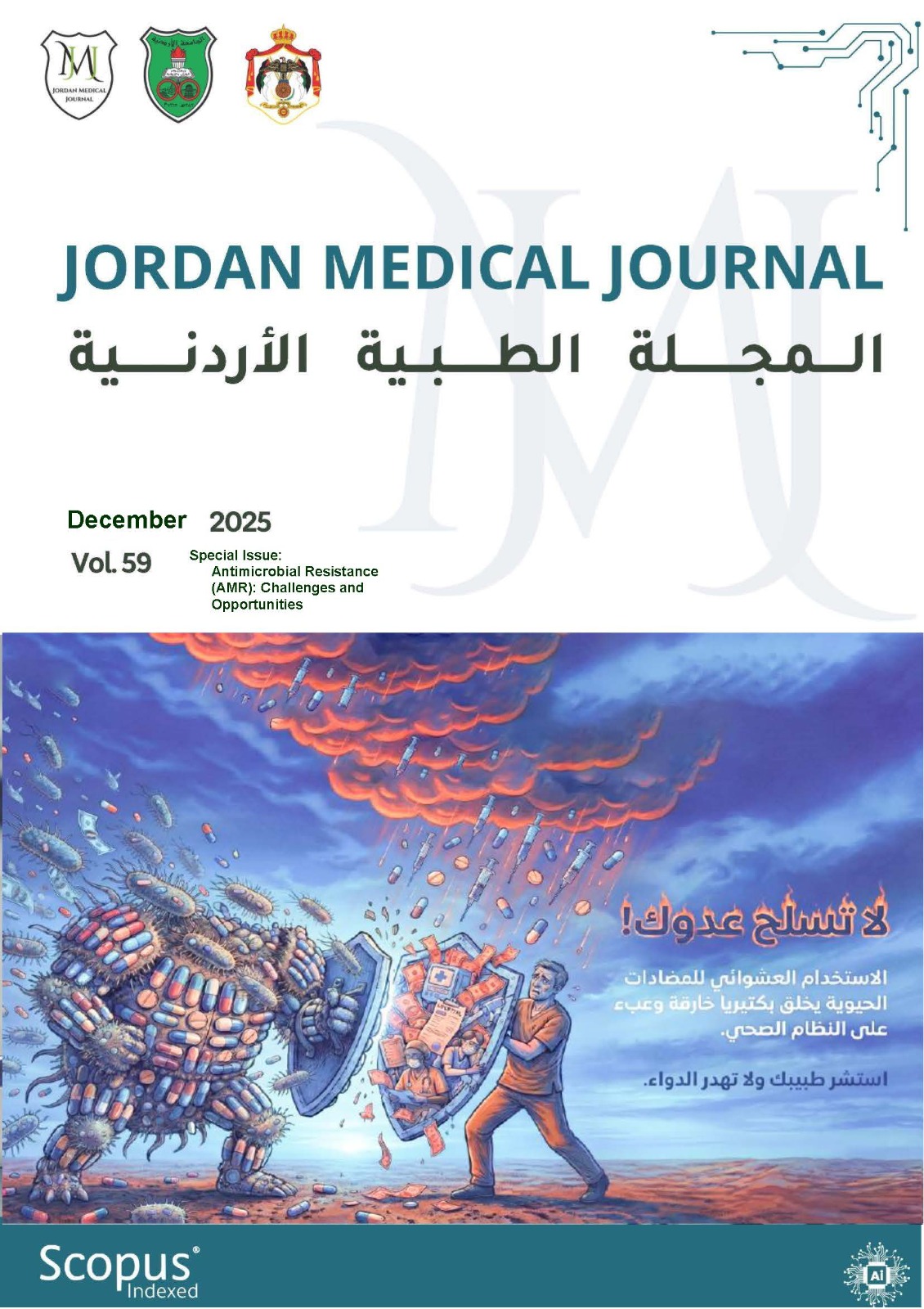
Editorial: Antimicrobial Resistance (AMR): Challenges and Opportunities, A Special Issue of the Jordan Medical Journal
DOI:
https://doi.org/10.35516/jmj.v59i5.5350الملخص
A Brief View of the Global Situation of Antimicrobial Resistance (AMR)
Antimicrobial resistance (AMR) is undermining the effectiveness of life-saving treatments and placing populations at heightened risk, whether from common infections or even routine medical interventions [1]. In 2014, the “Review on AMR” projected that 10 million deaths caused by AMR could occur by 2050. This helped position AMR as one of the most pressing threats to health of the 21st century [2].
With the antimicrobial increasing use and misuse, microorganisms have developed AMR. The phenomenon of AMR refers to the potential of microorganisms including bacteria, viruses, fungi, and parasites to continue to grow in the midst of drugs designed to kill them [3]. Infections caused by antimicrobial-resistant organisms are not only difficult to treat, there is also an increased chance of severe illness and even death due to these infections [3].
AMR is an evolutionary phenomenon shown by all organisms through development of mutations in order to withstand the lethal environmental selection pressure which subsequently, makes these drugs ineffective. Thus, with the ever-increasing use of antibiotics in healthcare and agriculture, bacteria had huge opportunity to develop AMR [3].
As a response to this crisis, the May 2015 World Health Assembly adopted a global action plan on AMR, which outlines five objectives: 1) to improve awareness and understanding of AMR through effective communication, education and training; 2) to strengthen the knowledge through surveillance and research; 3) to reduce the incidence of infection through hygiene and infection prevention measures; 4) to optimize the use of antimicrobials in human and animal health; and 5) to increase investment in new medicines, diagnostic tools, vaccines and other interventions [4].
However, despite these calls and alarms, the current situation is still alarming. The findings of the recent “Global antibiotic resistance surveillance report 2025” are concerning. It showed the global resistance is extensive with wide regional variations, an increasing threat from Gram negative bacterial pathogens, higher levels of AMR are reported from settings with low AMR surveillance coverage report, and that AMR is disproportionately affecting low and middle income countries [1].
More specifically, the report highlights the following findings: one in six laboratories confirmed infections worldwide were caused by AMR bacteria, resistance was most common in urinary tract infections (1 in 3 infections), blood stream infections (1 in 6), and in gastrointestinal (1 in 15). Resistance was most common in South East Asia and Eastern Mediterranean regions (1 in 3), followed by the African region (1 in 5). Resistance was less frequent in the European region (1 in 10), and least frequent in the Western Pacific region (1 in 11) indicating wide regional disparity [1]. The report also indicates that AMR has increased by 40% between 2018 and 2023. In particular, resistance to carbapenems and fluoroquinolones is increasing among Gram negative pathogens including Acinetobacter spp, Escherichia coli, and Klebsiella pneumoniae. This is a concern as these antibiotics are used to treat severe and life-threatening infections [1].
One important and key strategy for addressing the AMR crisis has been the development of new antibiotics. However, antibiotic development has had several scientific and economic challenges over the years [5]. The WHO reports that only 13 new antibacterial agents have been developed since 2017, with only 2 representing a new chemical class. Overall, the timeframe required for developing these drugs and conducting clinical trials, the likelihood of failure, and the lack of innovation threaten the future of clinical interventions [6].
AMR also has economic implications and is globally draining resources from economies, including the health-care, agriculture, and food production sectors [7]. AMR might reduce the world’s gross domestic product (GDP) by 1.1% and its cost may exceed US$ one trillion annually after 2030 across the globe [8].
At present, the proposed approaches to mitigate global AMR crisis include: antibiotic stewardship, development of new antibiotics, combination therapy, phage therapy, probiotics and prebiotics, immunotherapy, repurposing existing drugs, alternative to antibiotics, education and public awareness, surveillance systems, environmental regulations, and one health approach [9].
In conclusion, AMR is a serious global threat that threatens treatment of infections and decades of medical progress. Urgent, coordinated global action is needed to preserve the effectiveness of antimicrobials for the future
Antimicrobial Resistance in Jordan: A Critical Moment for National Action
Jordan, like many countries in the region, is witnessing a steep rise in AMR [10,11]. National surveillance data demonstrate particularly alarming levels of resistance: Acinetobacter spp. exhibit carbapenem resistance exceeding 80%, Staphylococcus aureus continues to show high methicillin resistance rates, and extended-spectrum β-lactamase (ESBL) production is widespread among Enterobacterales. Community-acquired pathogens—including E. coli—demonstrate rising resistance to commonly used oral therapies, signaling diminishing effectiveness of first-line treatments and highlighting the urgent need for coordinated stewardship interventions [10-12].
Clinical and Public Health Significance
The clinical impact of these resistance patterns is profound. AMR prolongs illness, increases mortality risk, and substantially elevates healthcare costs. It compromises the safety of routine medical procedures, from surgical interventions to hematologic treatments, and limits therapeutic options for common infections [13]. At the community level, non-prescription antibiotic access, cultural expectations surrounding antibiotics, and misconceptions about viral illnesses continue to drive unnecessary consumption [14]. In this context, AMR has become both a medical and societal challenge, demanding a comprehensive response that integrates clinical stewardship, regulatory reinforcement, and public engagement.
The Role of Youth and Community Awareness
Amid rising resistance, Jordan has a unique opportunity to mobilize a new generation of healthcare professionals and community leaders. Youth—particularly university students in medicine, pharmacy, and allied health fields—hold considerable influence within families, academic institutions, and digital platforms, enabling them to serve as catalysts for behaviour change. Emerging national initiatives, such as youth-led AMR advocacy networks, social media campaigns, and peer-driven educational programs, demonstrate the effectiveness of combining scientific messaging with culturally resonant communication strategies [15,16]. These initiatives help bridge the gap between clinical practice and public expectations, particularly through mechanisms such as hospital-based AMR counselling committees that offer clear explanations to patients when antibiotics are not indicated.
Towards a Nationally Integrated Response
A sustainable national response to AMR requires multisectoral collaboration across academic institutions, healthcare providers, ministries, and community stakeholders. Strengthening stewardship programs, embedding AMR education within university curricula, improving transparency around prescribing decisions, and expanding community engagement efforts are essential pillars of this approach [17]. Integrating surveillance findings with awareness campaigns ensures that resistance data do not remain isolated within laboratories or policy documents, but instead inform public behaviour and clinical practice.
Purpose of this Special Issue
The Jordan Medical Journal (JMJ) has recently announced a call for a special issue titled “Antimicrobial Resistance (AMR): Challenges and Opportunities” for 2025. The purpose of this special issue is to present current national surveillance findings, expert reviews, clinical perspectives, and community-based models relevant to AMR in Jordan thereby elevating AMR as a shared national responsibility. The collection aims to highlight both the scientific realities revealed through surveillance and the societal dimensions of awareness, behaviour, and stewardship. This issue also seeks to support a unified national strategy that preserves antimicrobial effectiveness and strengthens Jordan’s resilience against the growing threat of resistance through interdisciplinary dialogue and evidence-based recommendations.
Contents covered by the special issue on AMR
A considerable number of manuscripts were received from researchers worldwide in response to the call for the special issue. Following a rigorous selection process by the Editor-in-Chief and Associate Editors, as well as a thorough anonymous peer review, nine articles were accepted for publication. This special issue features original research and review articles from highly recognized experts, covering AMR governance, epidemiological trends, resistance and virulence genes, public awareness, infection prevention and control, antibiotic stewardship, and the One Health approach.
Carbapenem-resistant Acinetobacter baumannii (CRAB) is among the most challenging bacterial pathogens and has become widely distributed throughout the Mediterranean region [18]. In Jordan, numerous reports have highlighted the increasing prevalence, impact, and severity of CRAB infections [18,19]. In this context, a study by Zueter et al., published in this special issue, demonstrated an increased prevalence of several virulence genes—specifically bap, OmpA, surA, PLD, paaE, and basD—alongside a high capacity for biofilm formation in clinical CRAB isolates from Jordan. These findings suggest mechanisms for the enhanced survival of CRAB in hospital environments and its significant resistance to treatment [20].
In the same vein, Kuruva et al., from India in their review on tracking A. baumannii in critical care, discuss the pathogen's behavior and spread, as well as the utility of quantitative PCR and whole-genome sequencing for rapid detection. The review also outlines various hospital control measures, emphasizing the importance of environmental monitoring and a One Health approach to combat AMR. Furthermore, the authors propose future research directions, including metagenomic surveillance, machine learning and modeling, and pangenome-guided drug discovery [21].
The increased prevalence of hospital-acquired infections, particularly in intensive care units (ICUs), remains a critical challenge in the fight against AMR. Analysis of bacterial isolates collected from 12 ICUs across Jordan revealed that 41.2% were multidrug-resistant (MDR), 17.5% were extensively drug-resistant (XDR), and 6.8% were pandrug-resistant (PDR). MDR rates were highest among Klebsiella (82%) and Acinetobacter (79%) species. Furthermore, the study identified key resistance genes, including blaKPC in K. pneumoniae, mecA in Staphylococci, blaCTX-M in E. coli, blaOXA-51 and blaOXA-23 in A. baumannii, and the vanA gene in E. faecalis [22].
A three-year retrospective study examining common isolates and the sensitivity patterns of blood cultures from pediatric cancer patients in Libya indicated that Gram-positive organisms were the most frequently isolated bacteria (58.2%), with S. aureus being the most prevalent. Pseudomonas aeruginosa and Klebsiella pneumoniae were the most common Gram-negative isolates; notably, a higher proportion of carbapenem resistance was observed in K. pneumoniae [23].
The antibiotic susceptibility and resistance genes of E. coli isolates collected from two tertiary centers in Jordan revealed that 57.8% of samples were resistant to cefoxitin, a resistance mostly mediated by the CMY-2 gene. Additionally, 38% were resistant to gentamicin, with 61.4% harboring the aac(6’)-Ib-cr gene, while 65.7% of isolates were resistant to ciprofloxacin—nearly all of which were positive for the gyrA gene. Notably, only 2% of isolates showed resistance to imipenem and meropenem. These findings are instrumental in guiding appropriate antibiotic therapy and combating the spread of resistant E. coli in Jordan [24]. Other previous studies investigating ESBLs rates and resistance genes in Jordan have similarly identified CTX-M as the most prevalent genotype [12,25,26].
An interventional randomized controlled study involving 132 hospitalized pediatric patients in Jordan identified administration errors as the most frequent antibiotic-related problem. These errors were reduced by 70.67% in the intervention group; furthermore, the incidence of side effects stemming from inappropriate antibiotic use was significantly lowered, alongside a reduction in the average length of hospital stay. The study concludes that clinical pharmacist interventions significantly enhance the appropriate use of antibiotics in pediatric settings [27].
Taha et al., study utilizing structured questionnaires among 238 Jordanian women of reproductive age revealed a 25.7% prevalence rate of antibiotic misuse. The findings showed weak associations between misuse and factors such as higher family income or larger family size, while a higher level of education was found to slightly decrease the likelihood of obtaining antibiotics without a prescription. Such misuse is a primary driver that facilitates the development of antibiotic resistance [28]. These findings are supported by a systematic review of antibiotic misuse in Jordan, which indicated a high prevalence rate of inappropriate use, particularly among children with upper respiratory tract infections [29].
A cross-sectional study utilizing the WHO multi-country public awareness questionnaire to assess AMR awareness in Jordan revealed that 85.1% of participants were unable to define antibiotic resistance correctly. Furthermore, 45.6% mistakenly believed that the common cold could be treated with antibiotics [30]. These findings align with a previous study indicating that 39% of medical university students incorrectly identified bacteria as the cause of the common cold. Such data underscores the urgent need for targeted public education campaigns to enhance awareness and rectify these persistent misconceptions [31].
Finally, Shedeed describes the factors contributing to the poor implementation of antibiotic stewardship by employing multi-level and polycentric governance theory. The review, extracted in part from the author's master’s thesis, maps and analyzes the key actors, institutional arrangements, and policy mechanisms that shape stewardship efforts. The author notes that stewardship governance remains fragmented, underfunded, and poorly implemented in low- and middle-income countries. To address these gaps, they propose an original Integrated Polycentric Glocal Governance Framework (IPGF), applying it to two case studies within the Middle East and North Africa (MENA) region to strengthen global antibiotic stewardship and mitigate the AMR crisis [32].
In conclusion, this Special Issue highlights the multifaceted nature of the AMR crisis. The featured research underscores a critical escalation in AMR of A. baumannii, E. coli, and K. pneumoniae—driven by complex genetic mechanisms and widespread clinical prevalence. The articles identify significant systemic gaps, including low public awareness, frequent antibiotic misuse, and fragmented governance. Mitigating AMR requires a unified, One Health approach that integrates clinical precision, public education, and policy reform.
المراجع
World Health Organization, WHO report Global antibiotic resistance surveillance report 2025, available on https://www.who.int/publications/i/item/9789240116337, accessed 15 December 2025.
GBD 2021 Antimicrobial Resistance Collaborators. Global burden of bacterial antimicrobial resistance 1990-2021: a systematic analysis with forecasts to 2050. Lancet 2024;404(10459):1199-1226. doi: 10.1016/S0140-6736(24)01867-1. 6.
Salam MA, Al-Amin MY, Salam MT, Pawar JS, Akhter N, Rabaan AA, Alqumber MAA. Antimicrobial Resistance: A Growing Serious Threat for Global Public Health. Healthcare (Basel) 2023;11(13):1946. doi: 10.3390/healthcare11131946.
World Health Organization, Global action plan on antimicrobial resistance, available on https://www.who.int/publications/i/item/9789241509763, accessed 15 December 2025.
Al-Tawfiq JA, Momattin H, Al-Ali AY, Eljaaly K, Tirupathi R, Haradwala MB, Areti S, Alhumaid S, Rabaan AA, Al Mutair A, Schlagenhauf P. Antibiotics in the pipeline: a literature review (2017-2020). Infection 2022;50(3):553-564. doi: 10.1007/s15010-021-01709-3.
Ekwueme CT, Anyiam IV, Ekwueme DC, Anumudu CK, Onyeaka H. Reconstructing the Antibiotic Pipeline: Natural Alternatives to Antibacterial Agents. Biomolecules 2025;15(8):1182. doi: 10.3390/biom15081182.
Craig M, Jernigan D, Laserson K, McBride S, Fairbanks J, Sievert D, Armstrong PA, Ewing Ogle H, Zucker H. Antimicrobial resistance at a crossroads: the cost of inaction. Lancet 2024;404(10458):1083-1085. doi: 10.1016/S0140-6736(24)01705-7.
Poudel AN, Zhu S, Cooper N, Little P, Tarrant C, Hickman M, Yao G. The economic burden of antibiotic resistance: A systematic review and meta-analysis. PLoS One 2023;18(5):e0285170. doi: 10.1371/journal.pone.0285170.
Ahmed SK, Hussein S, Qurbani K, Ibrahim RH, Fareeq A, Mahmood KA, Mohamed MG. Antimicrobial resistance: Impacts, challenges, and future prospects, Journal of Medicine, Surgery, and Public Health 2024;2,100081, doi.org/10.1016/j.glmedi.2024.100081.
Jordan Ministry of Health. National AMR Surveillance Report; 2024. Available on https://www.moh.gov.jo/ebv4.0/root_storage/ar/eb_list_page/jordan_national_amr_surveillance_report_2024_final.pdf. Accessed on 1 December 2025.
World Health Organization. Global Antimicrobial Resistance and Use Surveillance System (GLASS) Report; 2023. Available on https://www.who.int/initiatives/glass. Accessed on 1 December 2025.
Al-Jamei SA, Albsoul AY, Bakri FG, Al-Bakri AG. Extended-spectrum β-lactamase producing E. coli in urinary tract infections: A two-center, cross-sectional study of prevalence, genotypes and risk factors in Amman, Jordan. J Infect Public Health 2019;12(1):21-25. doi: 10.1016/j.jiph.2018.07.011.
O’Neill J. Tackling Drug-Resistant Infections Globally: Final Report and Recommendations. UK Government; 2016. Source: Wellcome Collection. Available at https://amr-review.org/sites/default/files/160518_Final%20paper_with%20cover.pdf. Accessed on 1 December 2025.
Abuirmeileh A, Samara S, Alkhodari A, Bahnassi A, Talhouni A, Hayalla, A. Antibiotic dispensing without prescription in Jordanian community pharmacies. A pharmacist's perspective. Bulletin of Pharmaceutical Sciences Assiut University 2014;37(1): 51-63. doi: 10.21608/bfsa.2014.62622.
Mitchell J, Khan SF, Almazidou C, Barón-Cruz A, Bazzi RA, Estrella-Porter P, Gicheru NK, Khatic K, Mosha MJ, Ungurenci M, Noali BEP, Wong K, Zanni F. Youth as change makers on antimicrobial resistance: an evidence-based call-to-action. Nat Commun 2025;16(1):10118. doi: 10.1038/s41467-025-66328-0.
World Health Organization. Antimicrobial resistance toolkit for youth engagement; 2024. Available at https://iris.who.int/server/api/core/bitstreams/d6be99ca-1494-4288-85eb-3613535124e2/content. Accessed on 1 December 2025.
Jordan CDC, Ministry of Health & WHO. Monitoring and Evaluation (M&E) Plan for the National Action Plan (NAP) for Combating Antimicrobial Resistance (AMR) 2023-2025. 2024. Available at https://jcdc.gov.jo/ebv4.0/root_storage/ar/eb_list_page/amr_me_plan_2023-2025_text_24_oct_v8_-_sm-endo-0.pdf. Accessed on 1 December 2025.
Al-Tamimi M, Albalawi H, Alkhawaldeh M, Alazzam A, Ramadan H, Altalalwah M, Alma'aitah A, Al Balawi D, Shalabi S, Abu-Raideh J, Khasawneh AI, Alhaj F, Hijawi K. Multidrug-Resistant Acinetobacter baumannii in Jordan. Microorganisms 2022;10(5):849. doi: 10.3390/microorganisms10050849.
Zueter ARM, Balawi HA, Balawi DA, Al-Tamimi M, Sawan HM, Binsuwaidan R, Shquair D, Abdelfattah A, Al-Momani H, Abdelqader R, Mharib T. Genetic diversity and phylogenetic analysis of carbapenem-resistant Acinetobacter baumannii clinical isolates in Jordan. Acta Trop 2025;268:107708. doi: 10.1016/j.actatropica.2025.107708.
Zueter ARM, Balawi DA, Balawi HA, Al-Tamimi M, Sawan HM, Binsuwaidan R, Shquair D, Mharib T, Al-Momani H. Virulence Molecular Epidemiology of Clinical Carbapenem-Resistant Acinetobacter baumannii: A Report from Jordan. JMJ 2025;59: Special Issue: Antimicrobial Resistance (AMR): Challenges and Opportunities.
Kuruva K, Rekha K, Naaz S, Mudhigeti N, Jothinathan MKD, Lakshmi MS, Ramalingam S. Tracking Acinetobacter baumannii in Critical Care: Environmental Surveillance and One Health Strategies for AMR Prevention. JMJ 2025;59: Special Issue: Antimicrobial Resistance (AMR): Challenges and Opportunities.
Al-Tamimi M, Jaber A, Aldajeh D, Al-Namora D, Altarazi A, Aolymat I, Altamimi K, Othman H, Abu-Muhaisin T, Isied W, Fehmi E, Al shalabi M, Abukhait Y. Multiple Drug-Resistant Bacterial Infections among Intensive Care Units – a Nationwide Study. JMJ 2025;59: Special Issue: Antimicrobial Resistance (AMR): Challenges and Opportunities.
Alfaqaih SM, Ghlio N. A Three-Year Retrospective Analysis of the common Isolated Microorganisms and the Sensitivity Pattern of Blood Culture in Children with Cancer. JMJ 2025;59: Special Issue: Antimicrobial Resistance (AMR): Challenges and Opportunities.
Shalabi MS, Al-Tamimi M, Albalwi A, Khasawneh AI, Al Balawi D, Altarawneh S, El-sallaq M, Albalawi H, AbuRaideh J. Molecular and Phenotypic Patterns of Antibiotic-Resistant E. coli in Jordan. JMJ 2025;59: Special Issue: Antimicrobial Resistance (AMR): Challenges and Opportunities.
Al-Tamimi M, Abu-Raideh J, Albalawi H, Shalabi M, Saleh S. Effective Oral Combination Treatment for Extended-Spectrum Beta-Lactamase-Producing Escherichia coli. Microb Drug Resist 2019;25(8):1132-1141. doi: 10.1089/mdr.2019.0065.
Zueter AM, Mharib T, Shqair D, Al-Tamimi M, Sawan HM, Zaiter A, Albalawi H, Al Balawi D. Multi-locus sequence typing of Escherichia coli isolated from clinical samples in Jordan. J Infect Dev Ctries 2024;18(4):571-578. doi: 10.3855/jidc.18810.
Abu-Oudeh DA, Albsoul-Younes AM. Appropriate Use of Antibiotics among Pediatric In-Patients: An Interventional Randomized Controlled Study. JMJ 2025;59: Antimicrobial Resistance (AMR): Challenges and Opportunities.
Taha H, Alhaddad O, Somrain L, Al-Shawabka A, Alshaibe K, Al Daher L, Alsharrah N, Alajmi J, Assad A, Alathienat A, Almemeh O, alkamees N, Al-Khalidi S. The prevalence of antibiotic misuse and its associated factors among women of reproductive age in Jordan. JMJ 2025;59: Special Issue: Antimicrobial Resistance (AMR): Challenges and Opportunities.
Al-magableh M, Eldos B, Aldughmi S, Bani Hamad L, Abdel Karim R, Damseh R, Khlouf M. A Systematic Review of Misuse of Antibiotics in Jordan. J MJ 2024;58 (3). doi: https://doi.org/10.35516/jmj.v58i3.998.
Hindawi A, Saleem G, Aljboor S, Alfakeer B, Alhwaitat R, Yousuf MS. A Cross-Sectional Study of Public Awareness of Antibiotic Resistance among Jordanian Population. JMJ 2025;59: Special Issue: Antimicrobial Resistance (AMR): Challenges and Opportunities.
Khriesat W, Khriesat M, Kassab M. Knowledge, Attitudes, and Practices of Medical University Students Toward Antibiotics and Antimicrobial Resistance. JMJ 2025;59(5). doi: 10.35516/jmj.v59i5.2604.
Shedeed E. The Global Governance of Antibiotic Stewardship: A One Health Scoping Review and the Integrated Polycentric Glocal Governance Framework (IPGF). JMJ 2025;59: Special Issue: Antimicrobial Resistance (AMR): Challenges and Opportunities.